
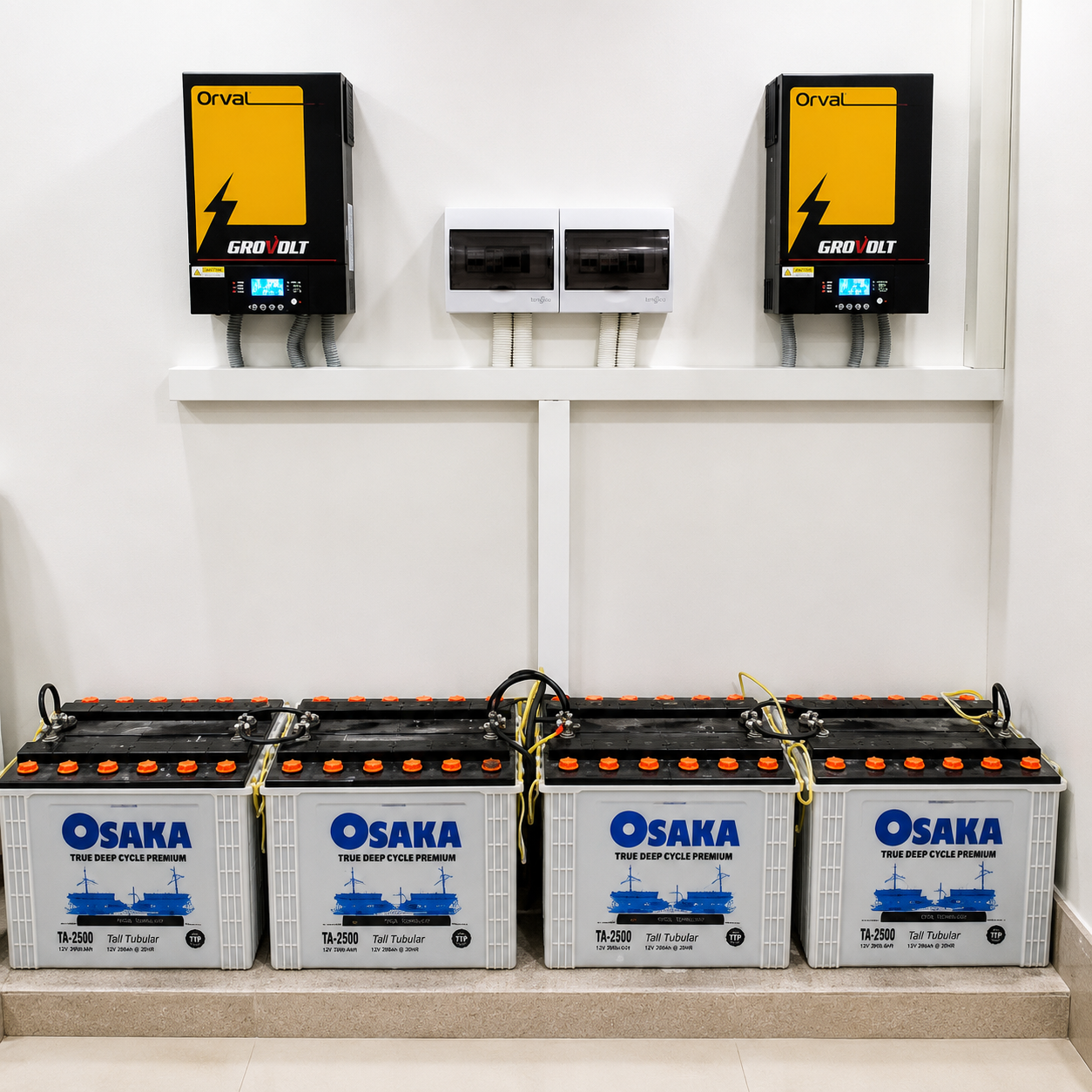
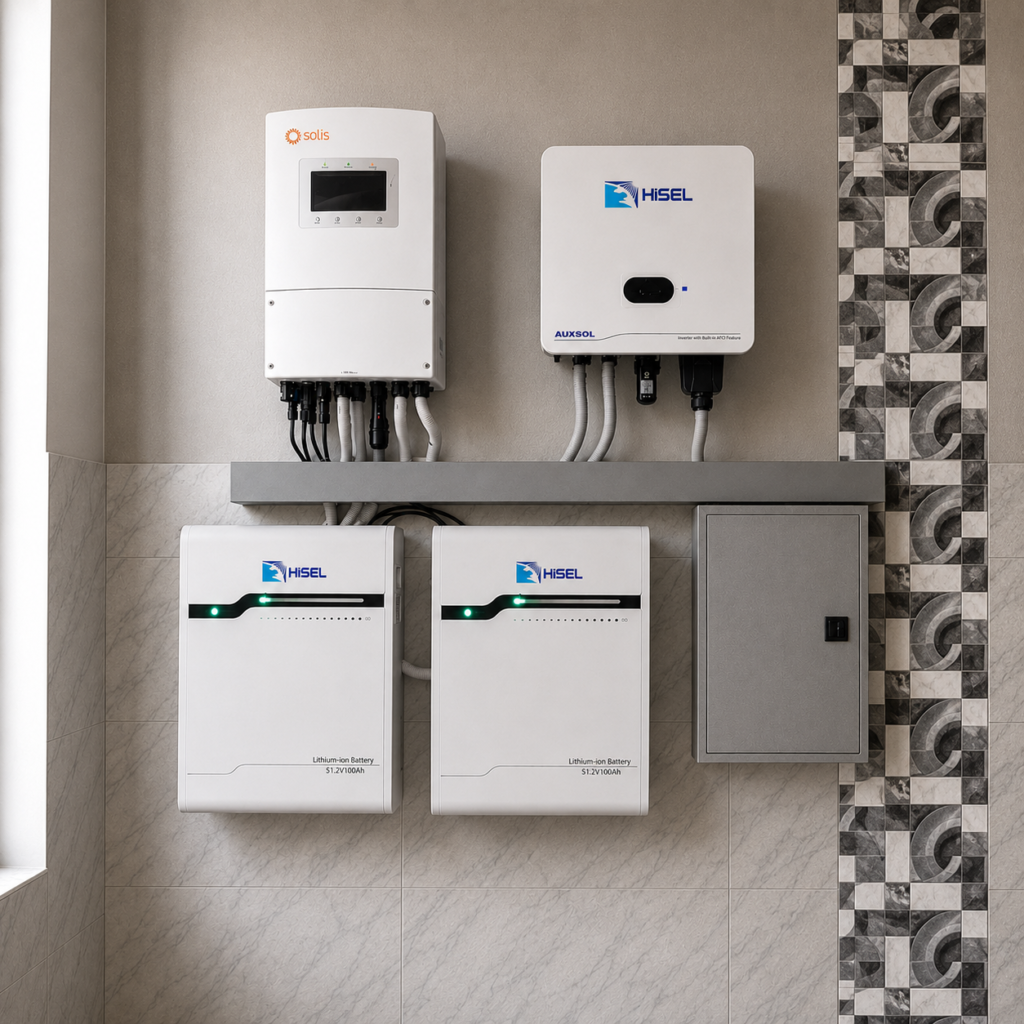
The honest answer is lithium for almost every home, and it is not close on anything except the first invoice. This page lays out the real differences rather than the sales version, including where tubular still makes sense.
Side by side
| Lithium (LiFePO4) | Tubular (lead-acid) | |
|---|---|---|
| Life | ~6,000 cycles, 10 to 15 years | ~1,500 cycles, 3 to 5 years |
| Usable capacity | 80 to 90% of rating | about 50% of rating |
| Round-trip efficiency | ~95% | ~80% |
| Charging | Fast; suits short winter sun | Slower |
| Maintenance | None | Water topping, ventilation |
| Space and weight | Wall-mounted, compact | Bulky, needs a ventilated area |
| Upfront cost | Higher | Lower |
The usable-capacity trap
This is the number most buyers miss. A “10 kWh” tubular bank is not 10 usable kWh. Lead-acid should not be discharged below about half, so you get roughly 5 kWh before you start shortening its life. A 10 kWh lithium bank gives you 8 to 9.
So a tubular bank that looks like the same capacity for less money is really about half the usable storage, bought three or four times over the life of the system.
Cost over the life, not on the day
Tubular wins the first invoice. Measured per usable kilowatt-hour across fifteen years, lithium is normally cheaper, because you buy it once. Add the replacement labour, the disposal, and the weeks of degraded backup before you get around to replacing a failing bank, and the gap widens.
Why net billing tilted this further
Since 9 February 2026 exported units earn about Rs 11 while units you use yourself save Rs 55 to 65. Storage is now the mechanism that captures that difference, so its efficiency matters directly. Lithium’s ~95 percent round trip against lead-acid’s ~80 means noticeably more of your daytime surplus survives to the evening. See our lithium guide and the 2026 net billing rules.
Where tubular still makes sense
We will fit tubular where the upfront budget is genuinely fixed and the backup need is small and occasional. Some of our own earlier installations use tubular banks, including a 33 kW system in DHA Phase 1 and a 10 kW in Model Town. It is a legitimate choice, it is simply not the cheaper one over time, and you deserve to be told that before you decide.
Frequently asked questions
Lithium or tubular battery for solar in Pakistan?
Lithium, for almost every home. It lasts roughly four times as long, gives you nearly double the usable capacity per rated kWh, needs no maintenance and charges faster. Tubular is cheaper on day one and that is its only advantage.
How long does a tubular battery last?
Typically three to five years in daily solar use, against ten to fifteen for lithium. Over a fifteen-year system life you would expect to buy a tubular bank three or four times.
Why can I only use half of a tubular battery?
Lead-acid chemistry degrades quickly if discharged deeply, so it should not go below about 50 percent. Lithium can safely use 80 to 90 percent of its rating, so a 10 kWh lithium bank gives 8 to 9 usable kWh where a 10 kWh tubular gives about 5.
Do tubular batteries need maintenance?
Yes. They need distilled water topped up periodically, ventilation because they emit gas while charging, and a dedicated space. Lithium needs none of that.
Is tubular ever the right choice?
Occasionally, where the upfront budget is hard-capped and the backup requirement is small and intermittent. We will fit it if that is genuinely your situation, but we will also show you the cost per usable unit over the life of both.
See how to size a battery or system prices including hybrid.
Deciding between the two?
Tell us your evening load and your budget on WhatsApp 0321 878 3630. We will price both honestly, including what each costs per usable unit over its life.
See current lithium battery prices to compare against a tubular quote.