
By Asif Niaz Meo, Managing Director, SNM Solutions · October 2026
The short version
MEPCO covers Multan, Bahawalpur, Dera Ghazi Khan, Sahiwal and the districts around them, including Muzaffargarh, Khanewal, Vehari and Rahim Yar Khan. To connect solar there you need a three-phase connection, an AEDB-approved installer to file the application online, and a hard copy to the MEPCO Net Metering Cell or your own SDO office. Since 9 February 2026 new applications settle under net billing, not the old net metering. One thing to watch: the capacity rule in MEPCO’s published checklist and the rule in the 2026 regulations do not match, so get yours confirmed in writing before you order panels.
Which districts MEPCO covers in south Punjab
MEPCO is the distribution company for most of south Punjab, and net metering there follows NEPRA’s national framework with MEPCO’s own checklist on top. If your bill says MEPCO, this page applies to you: Multan, Khanewal, Vehari, Sahiwal, Pakpattan, Lodhran, Bahawalpur, Bahawalnagar, Rahim Yar Khan, Dera Ghazi Khan, Rajanpur, Layyah and Muzaffargarh, along with the tehsils inside them. Lahore and its districts are LESCO, which runs a separate application process, so check the name printed on your bill before following any guide.
What changed for MEPCO net metering on 9 February 2026
NEPRA’s Prosumer Regulations replaced net metering with net billing for new applications from 9 February 2026. The practical difference is in the money, not the paperwork: units you export are bought at roughly Rs 11, while a unit you generate and use yourself saves you the full tariff, roughly Rs 55 to 65. Consumers who already held a net-metering agreement before that date keep their old terms until it expires. Our 2026 net billing guide explains the economics, and if you hold an older agreement, read what happens if you expand it before adding anything.
The MEPCO capacity rule: check this before you buy panels
This is where MEPCO applicants are most likely to get caught out, and we would rather point at it than pretend it is settled.
- MEPCO’s published checklist, the version dated October 2025 on its own website, says the load applied for the DG facility “must be equal or 1.5 times than load Sanctioned”, and repeats that the capacity “shall not exceed one and a half of the sanctioned load”.
- The 2026 Prosumer Regulations say the capacity shall not exceed the sanctioned load. No 1.5 times.
The notification MEPCO publishes alongside that checklist is also the older framework, S.R.O. 892(I)/2015. So the documents on the website describe the system as it worked before February 2026. In practice, size your system against the sanctioned load printed on your own bill and ask your sub-division to confirm the limit they are applying today, in writing, before you order equipment. Our guide to DG capacity and sanctioned load explains how to read those two fields; the field names are the same on a MEPCO bill.
Who can apply for MEPCO net metering
- Three-phase only. MEPCO states that only consumers with a three-phase meter are eligible. A single-phase connection must be upgraded first at the SDO office, which is a separate application with its own cost and waiting time.
- Through an AEDB-approved installer. MEPCO’s checklist says installation is “only allowed from AEDB approved Installers/vendors”, and that the application must be uploaded online by the approved installer. The online submission is therefore your installer’s job, even though the application is in your name and you sign it.
- Up to 1 MW. MEPCO’s checklist states the maximum capacity for the facility is 1000 kW. That document predates the 2026 regulations, so confirm it still applies if you are planning anything near that size.
- Name match. The applicant’s name and the name on the electricity bill must be the same. If they differ, the bill has to be transferred at the SDO office first. This single mismatch delays more applications than any technical issue we see.
Documents MEPCO asks for with a net metering application
Taken from MEPCO’s own checklist. Your installer prepares most of it, but the items in the first group are yours to produce:
| Who provides it | What is required |
|---|---|
| You | Attested CNIC of the applicant and of the witnesses; copy of the last paid electricity bill with a matching name; affidavit on non-judicial paper (Schedule-VI) |
| Your installer | Technical data for panels and inverters; schematic and single line diagram; site plan showing the external disconnect switch; installation and inspection certificate from the AEDB-approved vendor; the consumer-installer agreement AEDB requires |
| The forms | Interconnection agreement (Schedule-I), standard DG application form (Schedule-II), NEPRA licence application (Schedule-III), exemption application under section 24 (Schedule-IV), fee schedule (Schedule-V), generation licence template (Schedule-VII) |
| Above 250 kW | Certificate from the Electrical Inspector, and a load flow study |
| Companies | CUIN certificate, NTN/STRN, memorandum or articles of association, and an authority letter naming the person signing the file |
The inverter must be grid-tied with anti-islanding protection, which is standard on any reputable brand but worth confirming on the datasheet rather than assuming.
Where a MEPCO application goes: Multan head office or your SDO
The installer uploads it online, and the hard copy goes to the MEPCO Net Metering Cell at MEPCO headquarters in Multan, or to the concerned CE, SE, XEN or SDO office depending on which authority sanctioned your load. Smaller domestic connections are handled at sub-division level; larger commercial and industrial loads go higher up. Your installer should know which office yours belongs to before the file is printed.
On timelines, the regulations published on MEPCO’s own net-metering page are the 2015 ones, S.R.O. 892(I)/2015. Those require the company to acknowledge an application within five working days and say whether the file is complete, and give the applicant seven working days to supply anything missing. Since the 2026 Prosumer Regulations replaced that framework, treat those day counts as the older published standard rather than a commitment about your file today, and ask your sub-division what it works to now.
One deadline MEPCO applicants forget
MEPCO’s checklist states that the licence stands revoked if generation does not commence within six months of the licence being granted. If you are applying before the equipment is financed or the roof is ready, ask whether that clock still applies, because it decides whether you should file now or later.
Our solar installations in Multan and Muzaffargarh
Real systems, with the equipment actually fitted and the output recorded:
| Size | Location | Equipment | Output |
|---|---|---|---|
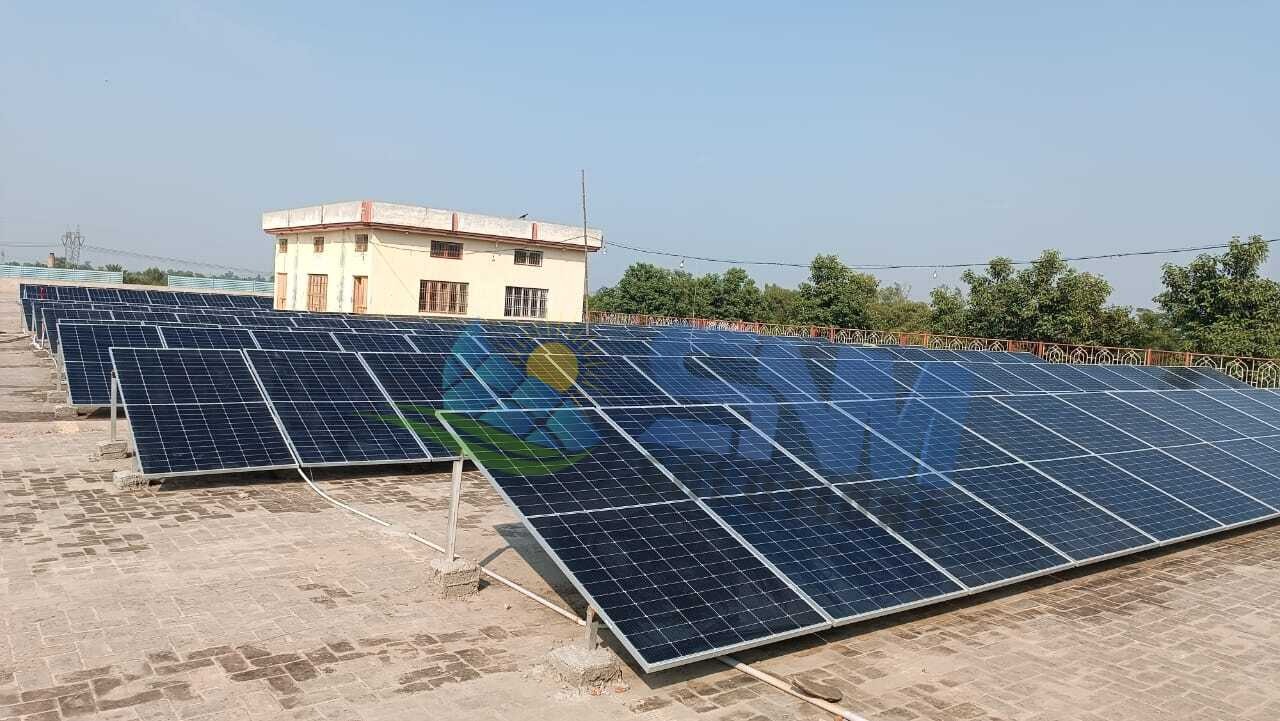
| 300 kW | Abdalian School, Muzaffargarh | 512 × 585 W JA N-type bifacial panels; 3 × 110 kW Solis on-grid inverters; green meter | 459,900 kWh per year |
| 110 kW | Al Asif Rice Mill, Muzaffargarh | 110 kW Solis on-grid inverter; SNM high-efficiency panels | 460+ units per day |
| 36 kW | Multan | 30 kW Solis on-grid + 6 kW Solis hybrid inverter; 10 kWh lithium bank; 715 W panels | — |
| 10 kW | DHA Multan | 10 kW Growatt on-grid inverter; 715 W panels | 40+ units per day |
The two Muzaffargarh projects are the kind of load that suits net billing best: a school and a rice mill both consume most of what they generate while generating it, so very little is exported at the low rate.
What about MEPCO net metering fees?
We are not going to publish a fee table for MEPCO, and you should be careful with pages that do. MEPCO’s checklist includes a Fee Schedule form but states no amounts, and the figures circulating on third-party sites contradict each other outright, from a few thousand rupees to tens of thousands, with some claiming the connection is free below a certain size. We have no way to verify any of them, so quoting one would simply be guessing with your money.
What the 2026 regulations do set out is a NEPRA licence fee in the order of Rs 1,000 per kW, and that systems of 25 kW and below no longer need NEPRA’s concurrence, which covers most homes. That removes one approval, not the process: your distribution company still approves the application and installs the meter. Ask your sub-division for the current fee schedule in writing, and ask your installer for an itemised quote that separates equipment, installation and the charges payable to MEPCO. Our solar system price guide shows what the equipment side of that quote should look like in Multan and the districts around it.
MEPCO net metering: frequently asked questions
Can I apply for MEPCO net metering myself?
Not the online submission. MEPCO’s checklist requires that to be uploaded by an AEDB-approved installer, and installation is only allowed from AEDB-approved installers or vendors. The application is still in your name: you sign the forms and provide your CNIC, bill and affidavit.
Do I need a three-phase connection for solar in Multan?
Yes. MEPCO states that only consumers with three-phase meters are eligible. A single-phase connection must be upgraded first through the SDO office, which is a separate application.
How big a system can I install on a MEPCO connection?
The published maximum for the facility is 1 MW. The real limit for most people is their sanctioned load. MEPCO’s checklist still says one and a half times the sanctioned load, while the 2026 regulations say it shall not exceed the sanctioned load, so confirm the figure your sub-division is applying before ordering.
Is it still called net metering in MEPCO?
The application is still filed as a distributed generation and net metering application, and MEPCO’s forms use that name. The settlement for new applications since 9 February 2026 is net billing, which pays about Rs 11 for an exported unit.
What delays a MEPCO application most often?
The three MEPCO spells out as conditions are the ones worth checking first: the name on the electricity bill must match the applicant, the connection must be three-phase, and the technical documents must be complete. Each is fixable before filing, and each means a separate trip to the SDO office if it is found afterwards.
Does SNM Solutions work in the MEPCO region?
Yes. Our installations there include a 300 kW school system and a 110 kW rice mill in Muzaffargarh, and 36 kW and 10 kW systems in Multan.
MEPCO net metering: Roman Urdu mein aam sawalat
MEPCO net metering ki darkhwast khud de sakte hain?
Nahin. MEPCO ke checklist ke mutabiq darkhwast AEDB-approved installer hi online upload karega, aur tanseeb bhi AEDB-approved vendor hi kar sakta hai. CNIC, bill aur affidavit aap dete hain.
Kya three phase connection zaroori hai?
Ji haan. MEPCO kehta hai sirf three phase meter wale sarifeen ahl hain. Single phase hai to pehle SDO office se upgrade karwana parta hai, jo alag darkhwast hai.
System kitna bara laga sakte hain?
Had 1 MW hai, lekin asal had aap ke bill par likha sanctioned load hai. MEPCO ke purane checklist mein 1.5 guna likha hai jabke 2026 ke qawaneen kehte hain sanctioned load se zyada nahin. Is liye order se pehle apne sub-division se tehreeri tasdeeq lein.
Multan, Muzaffargarh, Bahawalpur ya DG Khan mein solar lagwana hai?
Send us your latest MEPCO bill. We will read your sanctioned load, tell you what size is approvable, and quote it itemised with the MEPCO charges shown separately. Call or WhatsApp 0321 878 3630 for a free site survey.