By Asif Niaz Meo, Managing Director, SNM Solutions · 22 September 2026
The short version
On 20 September 2026 the government opened Pakistan’s electricity market to direct trading. Under the new system, called CTBCM, a power producer can sell electricity straight to a buyer and send it over the national grid for a fee, known as electricity wheeling. For now it is only for consumers using more than 1 MW, which means large factories and commercial buildings. Households still get their bill from LESCO or their own distribution company, and the new market does not change how homes buy electricity. The viral claim that “a new company will send your bill” and that “double bills are coming” is not supported by any official announcement.
What was announced: Pakistan’s competitive electricity market (CTBCM)
Energy Minister Awais Leghari launched the competitive electricity market in a video message on 20 September 2026. The same day, the Independent System and Market Operator (ISMO) issued a request for proposals for the country’s first wheeling auction: 400 MW, with 800 MW planned over the next five years. Proposals are due by 20 November 2026.
The minister described it as the government “practically withdrawing from electricity procurement”. Until now the state has bought most electricity from power plants and resold it through the distribution companies (DISCOs) such as LESCO. Under the new market, eligible buyers and sellers agree prices between themselves.
What electricity wheeling means, in plain terms
Wheeling is renting the road. A power plant generates electricity, a buyer agrees to purchase it, and the national transmission and distribution network carries it from one to the other. The plant does not build its own wires; it pays a charge to use the existing grid.
The framework behind this is the Competitive Trading Bilateral Contract Market (CTBCM). “Bilateral contract” simply means an agreement between two parties: the seller and the buyer.
Who can use it now: the 1 MW rule
The first phase is limited to consumers using more than 1 MW. In practice that is industrial units, large factories and big commercial buildings. A typical home in Lahore uses a small fraction of that, and even a large shop or office is far below it.
The government has said ordinary consumers will be brought in later. According to Pakistan Observer’s report of 21 September, the minister indicated this will eventually include households using 200 or 400 units a month, and the Express Tribune reports he expects the expansion “over the next few years”. No date has been announced.
NEPRA wheeling charges: what it costs to use the grid
A buyer on this system still pays for the grid. NEPRA set the charges on 8 September 2026, uniform across the eleven former WAPDA distribution companies and K-Electric:
| Charge set by NEPRA (8 Sep 2026) | Amount |
|---|---|
| Use-of-system charge for buyers who come through the auction (transmission, distribution and cross-subsidy) | Rs 6.23 to Rs 19.62 per unit, by consumer category |
| Plus a fixed charge on sanctioned load | Rs 1 per kW per month |
| Open access outside the auction | Rs 19.17 to Rs 32.56 per unit |
| Stranded cost within the outside-auction rate | Rs 12.94 per unit at 11 kV; Rs 16.35 per unit at 132/66 kV |
The “stranded cost” line matters. It is the share of the system’s fixed costs, such as payments to power plants, that a departing buyer is asked to keep paying so the cost does not fall entirely on everyone who stays. The large gap between the auction rate and the outside-auction rate appears designed to steer buyers into the auction; The Nation described it as higher grid charges for industries that skip the auctions. NEPRA also fixed line-loss factors of 8.04% at 11 kV and 1.51% at 132/66 kV.
Fact check: “A new company will send your bill, and bills will be double”
This claim is spreading through short videos, including a widely shared news clip headlined that bills will now come from a new company and that “double bills” are coming. We checked it against the official statements and the regulator’s decision.
- Households: not part of the system yet. Your bill still comes from LESCO (or your own DISCO). There is no second bill.
- “Double bills”: we found no announcement, NEPRA decision or ministry statement saying bills will double or that consumers will receive two bills. The discussion in the clip itself is about the wheeling system and its costs, not about households receiving two bills.
- What is real: commentators argue that if large consumers leave, the fixed costs they used to share could fall more heavily on those who remain. That is a genuine policy debate, and it is exactly why NEPRA built a stranded-cost charge into the rates above. It is not the same as a bill doubling.
On household bills, energy expert Aafia Malik, quoted by Pakistan Observer, says the new system offers no immediate relief, and puts the current cost of electricity at around Rs 34 per unit before taxes and surcharges.
What it means for homes and small businesses
For now, nothing changes in how you buy electricity. The levers you control are the same as last month:
- Use less grid electricity in the day. Every unit your own panels produce and you use directly is a unit you do not buy; we work through the savings in how much solar saves in Pakistan. Under net billing, a self-consumed unit saves roughly Rs 55 to Rs 65, while an exported unit earns about Rs 11, so sizing to your daytime use matters more than ever.
- Check your sanctioned load before you size a system. It decides how much solar you can connect; see DG capacity and sanctioned load on your LESCO bill.
- Get your own numbers. Our solar calculator turns a monthly bill into a system size and a savings estimate.
What it means for factories above 1 MW
For large industrial users the new market opens a real choice: buy from a producer at a negotiated price and pay the grid charges above, or keep buying from the DISCO. It does not change a basic fact about rooftop solar. Units generated on your own roof and used on your own premises never travel over the grid, so no wheeling or use-of-system charge applies to them. For many factories the practical plan will combine the two: on-site solar for daytime load, and whatever supply contract works best for the rest.
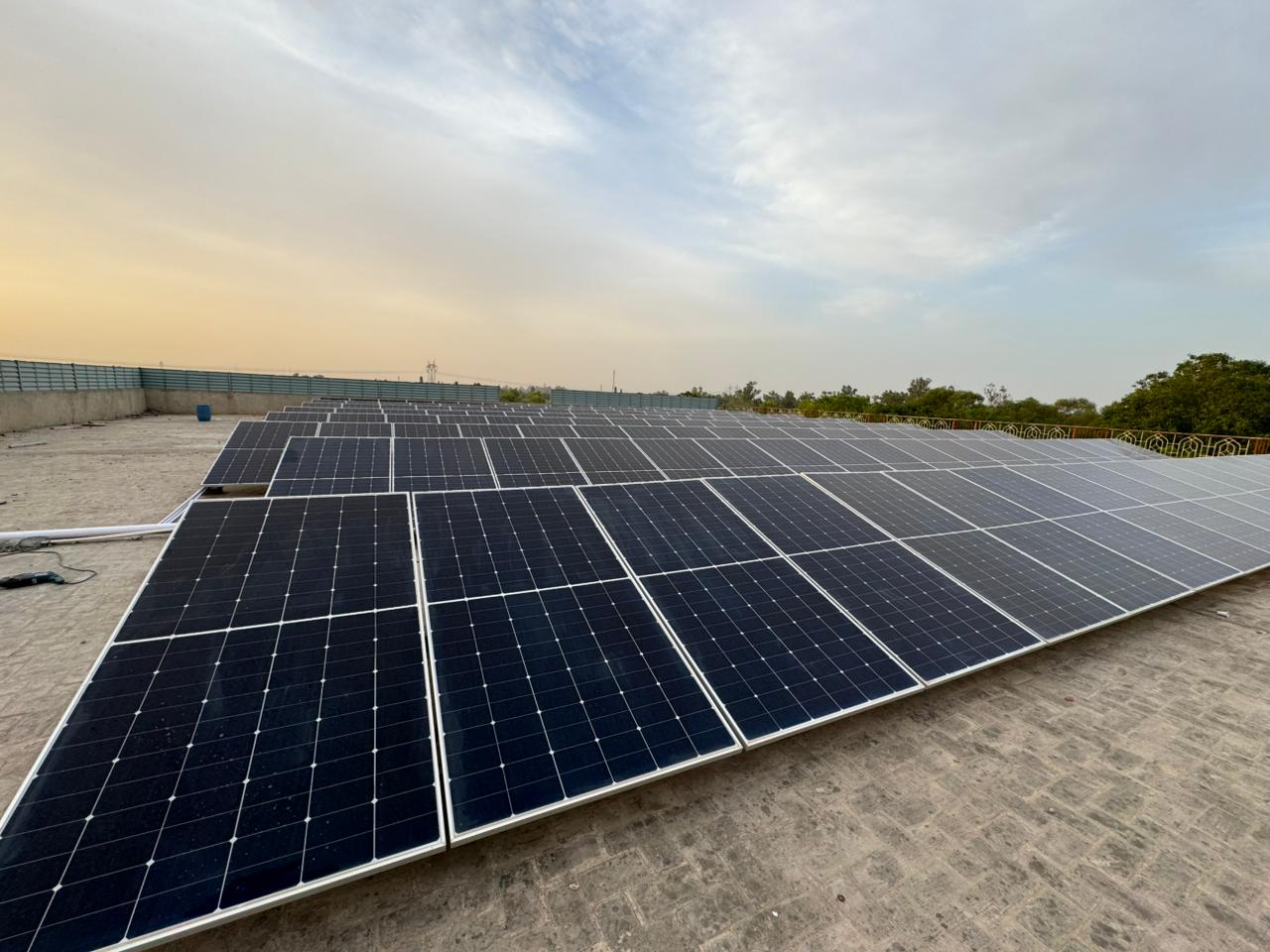
We have installed commercial and industrial systems including a 300 kW plant at Quaid-e-Azam Industrial Estate, Lahore and a 375 kW system on Raiwind Road. If you run a business, our guide to solar for shops, offices and commercial premises covers sizing and payback.
Electricity wheeling in Pakistan: frequently asked questions
What is electricity wheeling in Pakistan?
Wheeling means a power producer sells electricity directly to a buyer and uses the national grid to deliver it, paying a use-of-system charge to the network. It is part of the Competitive Trading Bilateral Contract Market (CTBCM), launched on 20 September 2026.
Can a household buy electricity directly from a power company now?
No. The first phase is only for consumers using more than 1 MW. The government has said ordinary consumers, including homes using 200 or 400 units a month, will be included later, over the next few years. No date has been set.
Will a new company send my electricity bill?
No. Households continue to be billed by their distribution company, such as LESCO, as before. The new system does not currently apply to domestic consumers.
Are electricity bills going to double?
No official announcement or NEPRA decision says so. Experts also say the system is unlikely to bring an immediate reduction in household bills.
What are the wheeling charges set by NEPRA?
For buyers who come through the auction, NEPRA set a use-of-system charge of Rs 6.23 to Rs 19.62 per unit depending on consumer category, plus Rs 1 per kW per month on sanctioned load. Outside the auction the rate is Rs 19.17 to Rs 32.56 per unit.
Does wheeling affect rooftop solar or net billing?
No. Rooftop solar used on your own premises does not travel over the grid, so wheeling charges do not apply to those units, and net billing is not affected by this announcement.
Wheeling aur bijli ka bill: Roman Urdu mein aam sawalat
Kya ab bijli ka bill nayi company bheje gi?
Nahin. Gharelu sarifeen ka bill pehle ki tarah LESCO ya apni distribution company hi bheje gi. Naya nizam abhi sirf 1 MW se zyada bijli istemal karne wale bade sarifeen ke liye hai.
Kya bijli ke bill double ho jayenge?
Kisi sarkari elaan ya NEPRA faisle mein aisa nahin kaha gaya. Mahireen ke mutabiq is nizam se gharelu bill mein foran kami ki bhi umeed nahin hai.
Wheeling kya hai?
Wheeling ka matlab hai ke bijli banane wali company apni bijli seedha khareedar ko bechti hai aur national grid ke zariye pohanchati hai, jis ke liye grid ko charges dene parte hain.
Sources
- Express Tribune, “Govt launches competitive power market for large consumers”, 20 September 2026.
- Geo News, “Govt ‘exits’ electricity purchase system as first-ever power wheeling auction begins”, September 2026; The Nation, “Power Division issues RFP for country’s first-ever electricity wheeling auction”, 21 September 2026.
- Geo News, “Nepra clears wheeling charges for bulk electricity consumers”, 8 September 2026.
- Pakistan Observer, “Pakistani consumers to buy electricity directly from power companies under new system?”, 21 September 2026.
Want to cut your grid units instead of waiting for the market to reach you?
Call or WhatsApp 0321 878 3630 for a free site survey and an itemised quote sized to your daytime use.